
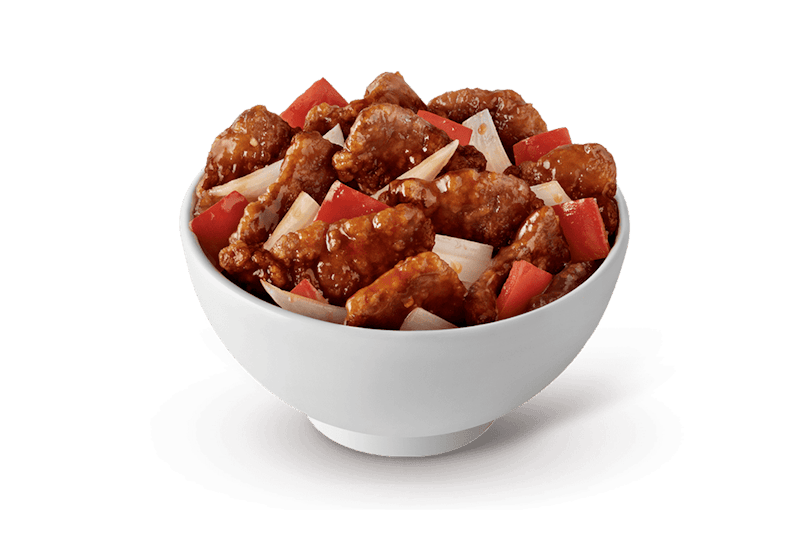
Quick answer: How many calories are in Panda Express Beijing Beef? The official-source snapshot used by this site lists 470 calories for the standard 5.6 oz serving. The same row has 27g of fat, 46g of carbohydrates, 2g of fiber, 14g of protein, and 600mg of sodium. A separate 4.2 oz Cub Meal entree row lists different values, so a complete estimate begins with the correct serving format.
Use the standard 5.6 oz row as the reference
The standard Beijing Beef row lists 470 calories, 27g of total fat, 46g of carbohydrates, 2g of dietary fiber, 14g of protein, and 600mg of sodium. These fields all belong to the same 5.6 oz serving. Keeping the weight and variant beside the numbers prevents a standard entree value from being mixed with a child-format portion or a complete meal.
Beijing Beef can be one of several lines in a Plate or Bigger Plate estimate. The 470 calories do not include a standard side, another entree, appetizer, beverage, or any other separately listed item. Add those components explicitly so the result shows what changed instead of hiding the meal behind a menu-format label.
- Calories: 470 per listed 5.6 oz standard serving.
- Total fat: 27g; carbohydrates: 46g; dietary fiber: 2g.
- Protein: 14g; sodium: 600mg.
Standard versus the 4.2 oz Cub Meal entree row
The “Beijing Beef – Cub Meal” entree row lists a 4.2 oz serving with 360 calories, 20g of fat, 35g of carbohydrates, 2g of fiber, 11g of protein, and 450mg of sodium. Use that row when the child-format entree portion is the intended serving. It is not interchangeable with the standard 5.6 oz row simply because both share the Beijing Beef name.
Do not derive the Cub Meal values by multiplying every standard metric by 4.2 divided by 5.6. The source already provides a separate named row, and published rounding or serving definitions may not follow exact proportional scaling. Selecting the printed 360-calorie row is more defensible than constructing a replacement value.
The Cub Meal entree row also does not represent an entire child meal by itself. A complete combination can include sides, a snack, and a beverage in separate fields or rows. When the question is about the full order, add those components rather than reporting 360 as though it includes everything in the meal.
Compare Beijing Beef with two chicken entrees
The standard Orange Chicken row lists 510 calories, 24g of fat, 53g of carbohydrates, 2g of fiber, 16g of protein, and 850mg of sodium. Beijing Beef is 40 calories lower, with 3g more fat, 7g fewer carbohydrates, the same listed fiber, 2g less protein, and 250mg less sodium. The Panda Express Orange Chicken Calories: Serving and Meal Guide guide explains the Orange Chicken serving in detail.
The standard Grilled Teriyaki Chicken row lists 275 calories, 10g of fat, 14g of carbohydrates, 0g of fiber, 33g of protein, and 470mg of sodium. Beijing Beef is 195 calories higher, with 17g more fat, 32g more carbohydrates, 2g more fiber, 19g less protein, and 130mg more sodium. These are comparisons between complete source rows, not judgments about which entree everyone should choose.
Add a side to see the full direction of the meal
One standard Beijing Beef serving plus Super Greens models to 600 calories. The same entree plus White Steamed Rice models to 990 calories, and with Chow Mein it models to 1,070 calories. The entree remains 470 in all three examples; the side row creates the difference. These are source-row additions, not measured claims about a specific box.
Use the Panda Express Super Greens vs White Rice: Calories and Nutrition and Panda Express Chow Mein vs Fried Rice Calories: Side Comparison comparisons to review how those sides change carbohydrates, fiber, fat, protein, and sodium as well as calories. A side choice can affect the complete nutrition profile in a different direction from the entree comparison.
- Beijing Beef + Super Greens: 600 modeled calories.
- Beijing Beef + White Rice: 990 modeled calories.
- Beijing Beef + Chow Mein: 1,070 modeled calories.
Build a Bigger Plate estimate one row at a time
A modeled combination of Super Greens, Beijing Beef, Orange Chicken, and Grilled Teriyaki Chicken adds to 1,385 calories: 130 plus 470 plus 510 plus 275. The example illustrates a three-entree calculation using the standard source rows. It does not include any additional sauce, appetizer, dessert, or caloric drink, and it does not promise that the assembled portions match every listed weight exactly.
Open the Panda Express calorie calculator, add the side first, and add each entree once. Increase only a repeated entree, then review the itemized Meal total before saving it. This workflow prevents the common error of multiplying one entree by three or assuming a Bigger Plate has one fixed nutrition value regardless of the items selected.
- 1. Select standard or Cub Meal Beijing Beef based on the serving format.
- 2. Add the exact side row and each additional entree separately.
- 3. Adjust quantities only for items that actually repeat.
- 4. Review calories and every available nutrition field in the receipt.
Treat the result as a portion-aware estimate
The official table offers a consistent named serving, while restaurant portions can vary with preparation batches, utensil fills, and the way several items share a container. A visual comparison cannot establish an exact multiplier. Keep the chosen row and serving weight in your notes, and describe the final number as an estimate rather than a measurement of the food received.
Nutrition totals also do not establish ingredient or allergen safety. Check the Menu guide and Nutrition page pages for the captured item and source columns, then confirm current ingredients, allergens, and cross-contact guidance when those details affect the order.
Verify the current official information
This guide uses the Panda Express nutrition snapshot captured August 17, 2026. Recipes, menu availability, serving practices, nutrition values, ingredients, and allergens can change. Use the official Panda Express nutrition page source for the final check, especially when an allergy, dietary restriction, or health decision is involved.
The direct standard-serving answer is 470 calories for the listed 5.6 oz row. The 4.2 oz Cub Meal entree row lists 360 calories. Select the intended format first, then add the side and every other entree to calculate the complete planned order.
Keep planning with the calculator
Use the linked tools to test the exact combination you are considering. Each destination keeps the serving label visible so your estimate stays tied to the same source row.
Last updated: August 17, 2026 Values are planning estimates from the dated official-source snapshot. Verify current nutrition, ingredients, allergens, and availability with Panda Express before ordering. Official nutrition source