
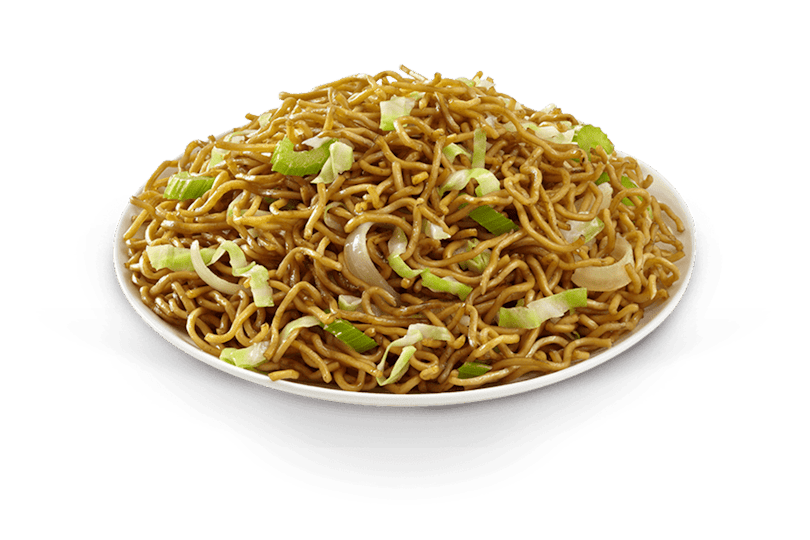
Quick answer: Which has fewer calories at Panda Express, Chow Mein or Fried Rice? In the official-source snapshot used by this site, the listed standard 11 oz Chow Mein serving has 600 calories and the listed standard 11 oz Fried Rice serving has 620 calories. Chow Mein is therefore 20 calories lower per published serving, but that narrow gap is only one part of the comparison.
Chow Mein and Fried Rice side by side
The fairest starting point is the standard side row for each item. Both rows list an 11 oz serving, so the 600-versus-620 comparison is not mixing different published weights. Chow Mein lists 23g of total fat, 94g of carbohydrates, 7g of dietary fiber, 15g of protein, and 1,000mg of sodium. Fried Rice lists 19g of total fat, 101g of carbohydrates, 1g of dietary fiber, 13g of protein, and the same 1,000mg of sodium.
Those numbers describe two complete standard side servings in the dated table. They are not measurements of the amount in a particular takeout box, and they do not automatically describe a half side. Keeping the item name, 11 oz serving, and nutrition row together makes the comparison useful instead of turning two calorie numbers into a promise about every restaurant scoop.
- Chow Mein: 600 calories, 23g fat, 94g carbs, 7g fiber, 15g protein, and 1,000mg sodium.
- Fried Rice: 620 calories, 19g fat, 101g carbs, 1g fiber, 13g protein, and 1,000mg sodium.
- Published serving size: 11 oz for either standard side.
What the 20-calorie difference does and does not mean
At the listed serving size, choosing Chow Mein instead of Fried Rice reduces the modeled side total by 20 calories. That is the correct arithmetic, but it is a small difference beside a 600-calorie side. An entree, appetizer, beverage, extra serving, or portion difference can move the complete order far more than those 20 calories. It is better to treat the gap as a precise comparison between two source rows than as the deciding feature of every meal.
The calorie result also does not establish that one side is universally healthier. A useful choice depends on the fields you care about, the rest of the order, portion expectations, ingredients, and personal needs. Calories can narrow a comparison, but the Nutrition page page shows why the carbohydrate, fat, fiber, protein, and sodium columns should stay visible beside the headline number.
Compare fat, carbs, fiber, protein, and sodium
Chow Mein has 4g more total fat than Fried Rice in the listed rows: 23g versus 19g. Fried Rice has 7g more carbohydrates: 101g versus 94g. The larger difference is dietary fiber, where Chow Mein lists 7g and Fried Rice lists 1g. Chow Mein also lists 2g more protein, at 15g compared with 13g. Sodium does not separate them in this snapshot because both rows list 1,000mg.
That pattern creates real trade-offs. The lower-calorie side is not the lower-fat side, while the higher-calorie side is not the higher-fiber or higher-protein side. If sodium is the main concern, swapping only between these two published servings does not change the modeled side sodium at all. Use the Menu guide to compare other side formats when the full profile matters more than staying within this two-item choice.
Add the side to the complete order
A side is only one line in a Plate or Bigger Plate estimate. Add the selected side row to each entree row rather than treating the menu format as a single calorie value. For example, the standard Orange Chicken row has 510 calories in this snapshot. One listed serving of Orange Chicken plus Chow Mein models to 1,110 calories, while the same entree plus Fried Rice models to 1,130 calories. The 20-calorie side difference remains 20 because the entree is unchanged.
That example is arithmetic from published rows, not a claim that every assembled plate weighs exactly 16.92 oz. Read the Panda Express Orange Chicken Calories: Serving and Meal Guide guide for the serving qualifier, then use the Panda Express calorie calculator to replace Orange Chicken or add the second and third entree you actually plan to order. The live receipt makes it clear which row and quantity created the total.
How to think about a half Chow Mein, half Fried Rice side
A half-and-half side raises a different question because the nutrition table provides full standard rows rather than a restaurant measurement for your individual split. If you model exactly half of each published 11 oz serving, the arithmetic is 300 calories from half the Chow Mein row plus 310 from half the Fried Rice row, or 610 calories. That is a transparent mathematical estimate, not a new official serving row.
Actual utensil fills and the visual dividing line in a container may not create two exact 5.5 oz portions. Do not present 610 as a guaranteed box total, and do not assume that “half” means half of a larger catering or a la carte container. When precision matters, record that you used a half-row model and keep the uncertainty attached to the result.
Calculate your side choice step by step
Use the calculator as a comparison worksheet before committing to a side. Build one version of the meal with Chow Mein, note the total, then remove only that side and add Fried Rice. Leaving the entree quantities unchanged isolates the 20-calorie side difference and shows the other nutrient changes without mental math. If the order is a Bigger Plate, add all three entree rows before comparing the sides.
- 1. Add the standard Chow Mein row and every planned entree to the calculator.
- 2. Save or note calories, fat, carbs, fiber, protein, and sodium for that meal.
- 3. Remove Chow Mein, add the standard Fried Rice row, and keep the entrees unchanged.
- 4. Compare the complete receipts, then label any half-side calculation as an estimate.
Check the dated source before ordering
This comparison uses the Panda Express nutrition snapshot captured August 17, 2026. Recipes, ingredients, availability, serving practices, and published values can change. The site is an independent planning tool and does not measure the food served at a particular location. Confirm current nutrition and allergen information with the official Panda Express nutrition page source when a change would affect your order or health decision.
The practical answer remains simple: the listed Chow Mein serving is 600 calories, the listed Fried Rice serving is 620, and the difference is 20 calories. Use that answer with the matching 11 oz rows, then calculate the entrees and any extras so the side comparison stays in the context of the complete meal.
Keep planning with the calculator
Use the linked tools to test the exact combination you are considering. Each destination keeps the serving label visible so your estimate stays tied to the same source row.
Last updated: August 17, 2026 Values are planning estimates from the dated official-source snapshot. Verify current nutrition, ingredients, allergens, and availability with Panda Express before ordering. Official nutrition source