
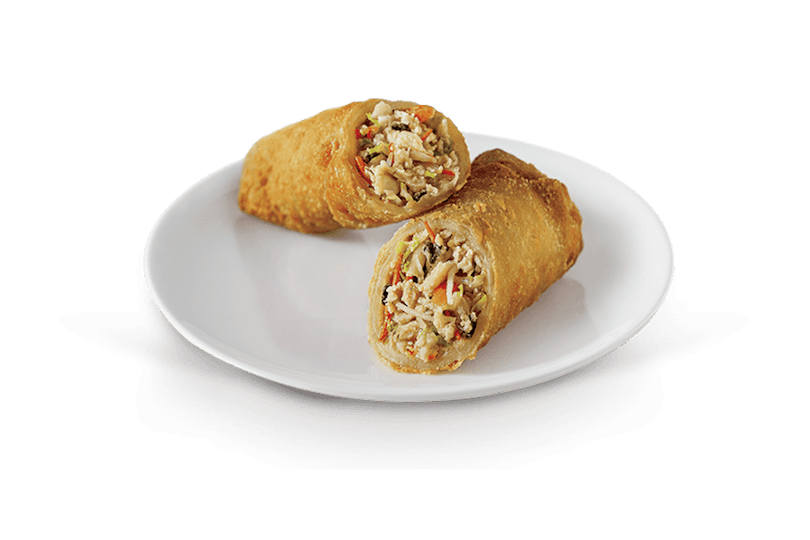
Quick answer: How do Panda Express Egg Roll and Spring Roll calories compare? The dated snapshot lists one Chicken Egg Roll at 200 calories and one standard Vegetable Spring Roll order of two rolls at 240 calories. The listed spring-roll order is 40 calories higher, but it also contains two pieces and weighs 3.50 oz compared with the egg roll’s one piece and 2.75 oz. Keep those units visible before comparing either appetizer.
Compare the two complete appetizer rows
The Chicken Egg Roll row is one 2.75 oz roll with 200 calories, 10g total fat, 2g saturated fat, 20g carbohydrates, 2g fiber, 2g sugars, 6g protein, 20mg cholesterol, and 340mg sodium. The Vegetable Spring Roll row is two rolls weighing 3.50 oz in total with 240 calories, 14g fat, 2g saturated fat, 24g carbohydrates, 2g fiber, 0g sugars, 4g protein, 0mg cholesterol, and 560mg sodium.
Comparing the complete listed orders, the spring rolls have 40 more calories, 4g more fat, 4g more carbohydrates, and 220mg more sodium. The egg roll has 2g more protein and 2g more listed sugars. Both rows list 2g saturated fat and 2g fiber. These differences describe the captured servings, not a universal ranking independent of quantity.
- Chicken Egg Roll: 1 roll, 2.75 oz, and 200 calories.
- Vegetable Spring Rolls: 2 rolls, 3.50 oz total, and 240 calories.
- Listed-order difference: 40 calories.
Why piece count changes the interpretation
The source compares one larger egg roll with two smaller spring rolls. Saying “a spring roll has 240 calories” hides the fact that 240 belongs to the two-roll row. Likewise, saying “the egg roll is lower calorie” is true for the complete listed orders but does not mean it is lower than one spring roll considered alone.
Dividing 240 by two gives a simple average of 120 calories per spring roll if the two pieces are treated as equal. That arithmetic can help model eating one of the two rolls, but the snapshot publishes the pair as its standard row and does not provide a separately measured one-roll profile. Label 120 as half of the listed order, not as a distinct official serving.
The same caution applies to fat, sodium, carbohydrates, and protein. Halving each field models half the order under an equal-split assumption. It cannot account for differences between individual pieces or prove that one roll weighs exactly 1.75 oz.
Add an appetizer to a complete meal
Appetizers are separate from the side and entree rows in a Bowl or Plate. If a Bowl totals 450 calories before an appetizer, adding one Chicken Egg Roll produces a 650-calorie model. Adding the complete two-roll Vegetable Spring Roll order produces 690 calories. Add the appetizer once; do not replace the entree or side unless the actual order changes.
If only one spring roll from the two-roll order is eaten, a transparent fractional model is 450 + 120 = 570 calories. Record that half of the published spring-roll row was used. If both rolls are eaten, use the full 240. The {{article:panda-express-bowl-vs-plate-calories}} guide explains how to construct the base meal before adding genuine extras.
Sauce packets or other extras need their own rows when available. Neither appetizer row automatically includes every optional dipping sauce in the calculator total. Do not add an assumed sauce amount or silently treat it as zero; list the exact extra selected so the estimate remains reviewable.
Calories are not the only difference
The complete spring-roll order is higher in calories, fat, carbohydrates, and sodium, while the egg roll is higher in protein and listed sugars. The rows also differ in total food weight and piece count. Which set of trade-offs matters depends on the meal being planned; the nutrition table can describe the options but cannot choose one for every person.
A per-piece calorie comparison answers a different question from a per-order comparison. Per order, use 200 versus 240. Under the equal-half model, one spring roll averages 120 calories, but eating two brings the total back to 240. State the comparison basis in the same sentence as the result so readers do not accidentally switch units.
Do not infer dietary or allergen safety from the names
“Vegetable” in an item name does not by itself establish that a current product meets a vegetarian, vegan, religious, or allergy-related requirement. Ingredients, preparation practices, shared equipment, and supplier formulations require current official confirmation. Likewise, the Chicken Egg Roll name does not provide a complete allergen statement.
The dated snapshot records different allergen fields for the two items, but an allergen table is not a guarantee against cross-contact or future recipe changes. Review the current official Panda Express nutrition page source and speak with the restaurant when an ingredient or allergen decision has safety consequences.
Account for portions and what was actually eaten
The source weights are standard references rather than scale measurements for every order. Individual rolls can vary in filling, retained oil, and weight. Use 2.75 oz and 3.50 oz to identify the captured rows, not to promise that every served piece exactly matches those numbers.
For a useful estimate, record whether the order contained one egg roll, one of the two spring rolls, or both spring rolls. Leftovers change consumed quantity even though they do not change the source row. A clear quantity record prevents the common error of logging 240 calories after eating only one piece or 120 after eating both.
Compare the exact appetizer rows in the calculator
Open the Panda Express calorie calculator and select Chicken Egg Roll (1 Roll) or Vegetable Spring Roll (2 Rolls). Confirm the quantity displayed before adding the item to a meal. The Menu guide preserves the public names, and the Nutrition page page shows all captured fields side by side.
This guide uses the Panda Express nutrition snapshot captured August 17, 2026. For those complete rows, the answer is 200 calories for one Chicken Egg Roll versus 240 calories for two Vegetable Spring Rolls. Verify current values, ingredients, allergens, and availability before ordering when those details matter.
Keep planning with the calculator
Use the linked tools to test the exact combination you are considering. Each destination keeps the serving label visible so your estimate stays tied to the same source row.
Last updated: September 1, 2026 Values are planning estimates from the dated official-source snapshot. Verify current nutrition, ingredients, allergens, and availability with Panda Express before ordering. Official nutrition source