
Quick answer: What is the calorie difference between a Panda Express Bowl and Plate? There is no single fixed difference because the selected entrees determine it. For a source-row estimate, a Bowl is one standard side serving plus one standard entree serving. A Plate is the same one side serving plus two entree servings. Therefore, the Plate adds the calories of its second entree; it does not automatically add a second full side.
The Bowl and Plate formulas use the same side count
Start with the items, not the container name. In a standard source-row model, a Bowl contains one side selection and one entree selection. A Plate contains one side selection and two entree selections. Write the Bowl as side + entree. Write the Plate as side + entree 1 + entree 2. If both Plate entree choices are the same item, count that entree row twice. If they differ, add each selected row once.
This structure explains why a Plate does not have one universal number of extra calories. Moving from a Bowl to a Plate adds whichever second entree is chosen. Adding a 150-calorie Broccoli Beef serving changes the model by 150 calories, while adding a 510-calorie Orange Chicken serving changes it by 510. The format alone cannot tell you which difference applies.
- Bowl: one standard side row + one standard entree row.
- Plate: one standard side row + two standard entree rows.
- Difference: the second entree row selected for the Plate.
A worked Bowl and Plate example
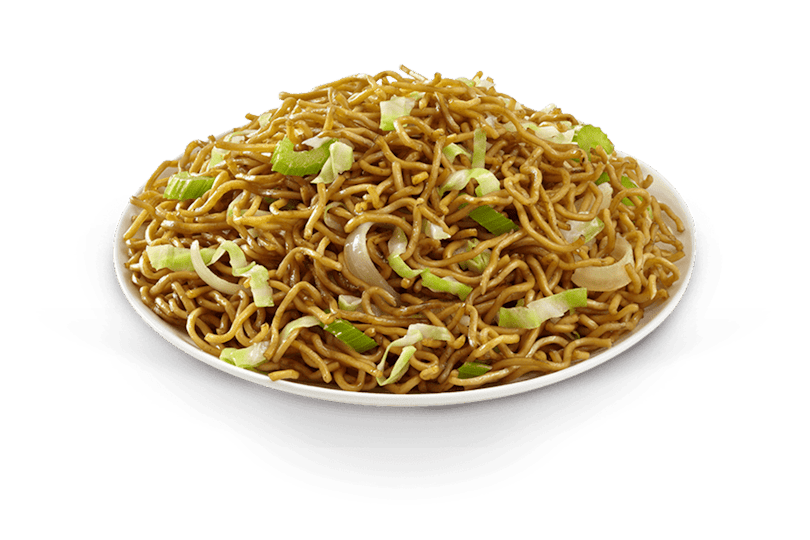
Consider Chow Mein and Orange Chicken. The dated snapshot lists 600 calories for one 9.40 oz standard Chow Mein serving and 510 calories for one 5.92 oz standard Orange Chicken serving. A Bowl model using those rows is 600 + 510 = 1,110 calories. The arithmetic represents one complete published serving of each named row; it is not a measurement of a particular takeout container.
Now make the same order a Plate and choose Broccoli Beef as the second entree. The snapshot lists Broccoli Beef at 150 calories for a 5.44 oz standard serving. The Plate model is 600 + 510 + 150 = 1,260 calories. The difference from the Bowl is 150 calories because the side and Orange Chicken rows stayed unchanged and only Broccoli Beef was added.
If the Plate instead contains two Orange Chicken servings, use 600 + 510 + 510 = 1,620 calories. Repeating an entree choice means repeating its row. It does not convert Orange Chicken into a larger unlisted serving, and it does not justify multiplying the side.
How to calculate a half-and-half side
A half-and-half side should be modeled as two halves that together equal one side selection. Do not add two complete side rows. For example, the snapshot lists White Steamed Rice at 520 calories per 11 oz standard serving and Super Greens at 130 calories per 10 oz standard serving. A simple half-row model is 260 calories for half the Rice row plus 65 calories for half the Super Greens row, totaling 325 calories.
The 325-calorie result is transparent arithmetic using one-half of each listed serving. It is not an official combined row and does not prove that the two scoops weigh exactly 5.5 oz and 5 oz. The named source rows use different weights, while restaurant portions can vary with preparation, utensils, and how the available side space is divided.
Use the Panda Express Super Greens vs White Rice: Calories and Nutrition guide when you want the full side comparison. In the Panda Express calorie calculator, enter 0.5 for each side quantity and verify that their quantities total one side. This keeps the assumption visible and avoids the common mistake of counting both as full servings.
Why the same format can produce very different totals
Side rows span a wide calorie range, and entree rows vary as well. That means two Bowls can have different totals even though each follows the same one-side, one-entree structure. Two Plates can differ by even more because each includes two entree choices. A format label is useful for counting components, but it is not a substitute for the actual item names and variants.
Keep variant labels visible. Standard, Cub Meal, appetizer, and complete-meal rows can share familiar words while using different serving weights. Do not insert a Cub Meal component row into an adult Bowl model merely because the entree name looks similar. The Menu guide helps match labels, and the Nutrition page page exposes the serving weight and every captured nutrition field.
Published serving rows are references, not scale readings
A calculation is only as precise as its serving assumption. The official-source rows provide consistent reference weights and nutrition values, but restaurant food is portioned from prepared batches. An individual scoop can be heavier or lighter than the listed row, and the balance of meat, vegetables, sauce, or noodles can vary. Treat the sum as a planning estimate rather than an exact laboratory result for the food in front of you.
Avoid trying to correct an observed portion by guessing from container volume. Fluid-ounce box labels and food weight in ounces are different measures, and ingredients have different densities. If a precise personal record matters, keep the source-row estimate labeled as such and separately record any measured food weights rather than presenting an improvised multiplier as official nutrition.
Build a reproducible total in the calculator
Open the Panda Express calorie calculator and add the exact side row first. Add one entree for a Bowl or two entree rows for a Plate. If a choice repeats, increase only that entree quantity. For a split side, use half quantities that total one complete side model. Review calories alongside protein, carbohydrates, fat, fiber, sodium, and the serving labels before saving the result.
This guide uses the Panda Express nutrition snapshot captured August 17, 2026. Recipes, serving practices, nutrition values, ingredients, allergens, and availability can change. Confirm current details with the official Panda Express nutrition page source when they affect your decision. The reliable format rule is simple: one side plus one entree for a Bowl, and one side plus two entrees for a Plate; the selected rows determine the final number.
- 1. Record the exact side and whether it is full or split.
- 2. Add one entree row for a Bowl or two for a Plate.
- 3. Check every serving weight and variant label.
- 4. Label the sum as a dated source-row estimate.
Keep planning with the calculator
Use the linked tools to test the exact combination you are considering. Each destination keeps the serving label visible so your estimate stays tied to the same source row.
Last updated: September 1, 2026 Values are planning estimates from the dated official-source snapshot. Verify current nutrition, ingredients, allergens, and availability with Panda Express before ordering. Official nutrition source