
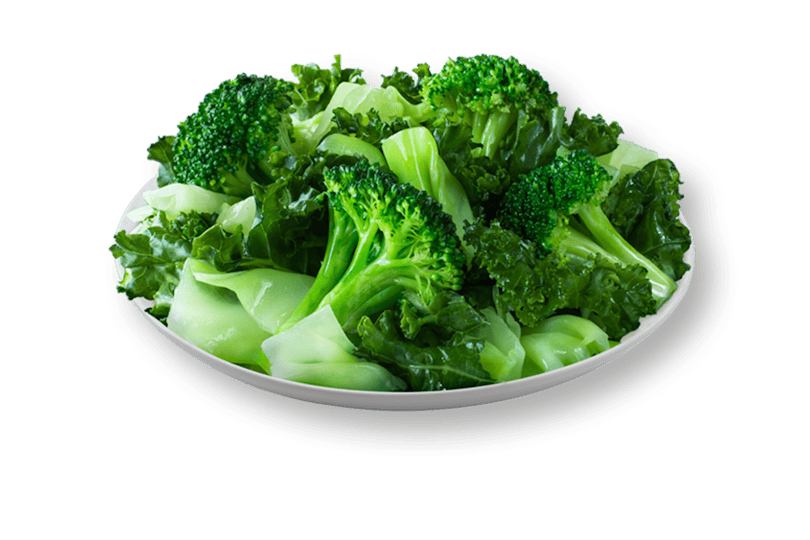
Quick answer: How do Panda Express Super Greens and White Rice compare? The dated official-source snapshot used here lists 130 calories for a standard 10 oz Super Greens serving and 520 calories for an 11 oz White Steamed Rice serving. Super Greens is 390 calories lower per listed serving, while the other nutrition fields show trade-offs that a calorie-only answer would miss.
Compare the two published side servings
Super Greens and White Steamed Rice are not identical serving weights in the source table. Super Greens lists a 10 oz standard serving with 130 calories, 4g of total fat, 14g of carbohydrates, 7g of dietary fiber, 9g of protein, and 370mg of sodium. White Rice lists an 11 oz serving with 520 calories, 0g of fat, 118g of carbohydrates, 0g of fiber, 10g of protein, and 0mg of sodium.
The one-ounce serving difference matters when describing the comparison, but it does not erase the much larger nutrition differences between the named rows. Use 130 and 520 as the values for the complete listed servings. Do not present them as per-ounce numbers or assume a restaurant employee will place exactly the source weight into every container.
- Super Greens: 130 calories per listed 10 oz serving.
- White Steamed Rice: 520 calories per listed 11 oz serving.
- Difference: 390 calories between the complete standard rows.
What the 390-calorie difference means
Subtracting 130 from 520 gives a 390-calorie difference. If every entree and extra stays the same, replacing the listed White Rice row with the listed Super Greens row reduces the modeled complete meal by exactly 390 calories. This makes the side a major part of the total, especially compared with the 20-calorie gap in the Panda Express Chow Mein vs Fried Rice Calories: Side Comparison comparison.
The arithmetic is useful, but “lower calorie” is not a complete recommendation. Rice and vegetables create different textures, flavors, carbohydrate amounts, fiber values, fat values, and sodium totals. Some customers may prioritize the overall energy estimate, while others are comparing carbohydrate availability, sodium, ingredients, preference, or how the side works with a particular entree. The numbers support the decision; they do not make the same decision for everyone.
Carbs, fiber, fat, protein, and sodium move differently
White Rice lists 118g of carbohydrates, while Super Greens lists 14g, a difference of 104g per published serving. Super Greens lists 7g of fiber compared with 0g for White Rice. Protein is close: 9g for Super Greens and 10g for White Rice, so the rice row is 1g higher. The direction changes again for fat and sodium. Super Greens lists 4g of fat and 370mg of sodium; White Rice lists 0g for both fields in this snapshot.
Those cross-currents are why it is inaccurate to call either row better in every respect. Super Greens is lower in calories and carbohydrates and higher in fiber, yet White Rice is lower in listed fat and sodium and slightly higher in protein. Read the exact columns on the Nutrition page page and consider the complete meal rather than promoting one field as a universal score.
- Carbohydrates: 14g in Super Greens versus 118g in White Rice.
- Fiber: 7g versus 0g; protein: 9g versus 10g.
- Fat: 4g versus 0g; sodium: 370mg versus 0mg.
See how each side changes an entree total
The standard Orange Chicken row has 510 calories in this snapshot. Adding the listed Super Greens serving produces a modeled 640-calorie combination. Adding White Rice to the same entree produces a modeled 1,030-calorie combination. The only changed row is the side, so the complete totals remain 390 calories apart. The Panda Express Orange Chicken Calories: Serving and Meal Guide guide explains why the entree value must stay attached to its 5.92 oz serving.
A Plate or Bigger Plate with additional entrees requires more rows. Start with the side, add each entree once, then increase only the quantity that actually repeats. The Panda Express calorie calculator maintains that itemized receipt and totals calories, fat, carbohydrates, fiber, protein, and sodium from the same selections. This is clearer than applying a generic Plate multiplier to one side or entree number.
Model a mixed side without inventing an official portion
If you want a half Super Greens and half White Rice estimate, define the assumption first. Exactly half of the published Super Greens row is 65 calories, and exactly half of the White Rice row is 260 calories, producing a 325-calorie mathematical model. Because the source servings are 10 oz and 11 oz, that model represents 5 oz of Super Greens plus 5.5 oz of rice rather than two equal-weight portions.
A restaurant split may use different scoop amounts, so 325 should not be labeled as an official half-side value or a measured total for the container in front of you. Keep the calculation described as “half of each listed row” and avoid inventing precision from the visual dividing line. You can also model a full serving of either item when that better matches what you expect to receive.
Questions to ask before choosing the side
Begin with the complete order: which entrees, quantities, appetizer, drink, or sauce will accompany the side? Then decide which comparison fields matter for that meal. The 390-calorie and 104g carbohydrate differences are substantial in the published rows, but the 370mg sodium difference points in the opposite direction. Taste, texture, ingredient compatibility, and availability can be as important as the numbers.
Use the Menu guide to confirm that you selected the standard side rather than a Cub Meal or another format. Add the complete rows in the calculator, compare the two receipts, and keep portion uncertainty in the result. Nutrition information can support planning, but this independent site does not provide medical advice or determine which side fits an individual health requirement.
- 1. Keep the entree list and quantities unchanged for a fair side comparison.
- 2. Compare calories and carbohydrates alongside fiber, fat, protein, and sodium.
- 3. Label a mixed-side calculation with the exact half-row assumption used.
- 4. Recalculate when the serving format or complete order changes.
Verify the current source before ordering
This guide uses the Panda Express nutrition snapshot captured August 17, 2026. Published values, recipes, ingredients, availability, and serving practices can change. Confirm current nutrition and allergen details with the official Panda Express nutrition page source, especially when a dietary restriction or allergy affects the decision. A nutrition row cannot establish ingredient safety or cross-contact conditions.
For this snapshot, the direct answer is 130 calories for the 10 oz Super Greens row and 520 calories for the 11 oz White Rice row. That is a 390-calorie difference. Keep the different serving weights and the contrasting macro and sodium values visible, then add the chosen row to the rest of the planned meal.
Keep planning with the calculator
Use the linked tools to test the exact combination you are considering. Each destination keeps the serving label visible so your estimate stays tied to the same source row.
Last updated: August 17, 2026 Values are planning estimates from the dated official-source snapshot. Verify current nutrition, ingredients, allergens, and availability with Panda Express before ordering. Official nutrition source